
The trade deal, officials say, can lead to an effective trading bloc against the China-led Regional Comprehensive Economic Partnership.
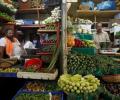
Since March 2020, WPI food inflation rate continued to fall but the CPI-food inflation rose, signaling a breakdown in supply chain from the mandis to the final household.

This includes an infrastructure push which may lead to the government spending more than its budgeted capital expenditure for 2020-21. There are also discussions on increasing the scope and quantum of direct cash transfers to the beneficiaries who need it the most.

Till date, MP has procured around 12.77 million tonnes of wheat, which is expected to reach 13 million tonnes by the time the process ends in the next few weeks.
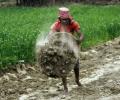
Kiran Vissa, co-convenor of National Alliance for Sustainable Agriculture, said that amendments to the EC Act have nothing to do with farmers' welfare but instead meant to please big players and agriculture companies. This is because small and marginal farmers don't have the storage capacity to attract provisions of the EC Act.

'Given the 50 per cent or thereabouts increase in borrowing that has been announced, it is a reasonable estimate to say that at this time, an increase of 1.7-1.8 per cent on the 3.5 per cent budgeted fiscal deficit target is being anticipated,' Chief Economic Adviser Krishnamurthy Subramanian said on Friday.

'It is a package for a new self-reliant India.'
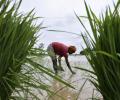
As the growth figures relate to pre-Covid lockdown period it does not reflect the real picture of distress which unfolded from April onwards in the sector, when acute supply disruption led to sharp drop in prices of many commodities largely perishables impacting farmers.

This comes at a time when the COVID-19 crisis is expected to derail the government's revenue maths for 2020-21, hitting the mop-up from sources such as taxes and divestment.

The locusts initially entered Rajasthan from Pakistan and from there the swarms moved towards Madhya Pradesh, Haryana, and Punjab over the last few weeks and are now threatening to enter Uttar Pradesh, putting at risk the summer crop.

These conditions are implementation of the 'One Nation, One Ration Card' scheme, ease of doing business, power sector reforms, and urban local body reforms.

'The spirit of cooperation between the Centre and states has been diluted in many ways.' 'The level of consultation which used to be there earlier has reduced significantly.'

The government is looking at tweaking provisions of the Indian Contracts Act of 1872 to bring agreements between farmers and companies under its ambit, aiming to prevent exploitation of farm people.

Later, there may be some tax relief aimed at the middle class and measures to benefit the sectors worst hit by Covid-19 and the resultant nationwide lockdown.

There could be multiple measures announced in quick succession, not only by the finance minister but also other ministers regarding their respective sectors, and by the Reserve Bank of India. The total size of these announcements could rival that of other G-20 nations as a percentage of GDP.
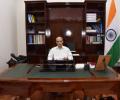
The finance minister is ready to present a second financial package. The Centre has ruled out a mega stimulus and will rely on targeted, incremental packages. Industry is clamouring for a bailout, the liquidity upheaval in capital markets is nowhere close to being sorted out, and all budgetary forecasts now stand irrelevant, reports Arup Roychoudhury.
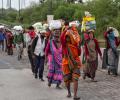
The beneficiaries of the second set of announcements are expected to be micro, small, and medium enterprises, farmers, women, poor, migrant workers, and other marginalised sections of the society, reports Arup Roychoudhury.
In total, the Centre plans to purchase around 40.7 million tonnes of wheat from farmers this year, which is almost 19 per cent more than last year.

'The numbers are null and void now. Look, we can give out projections now, but we know that a week later those numbers will also be irrelevant. So we need to wait,' a top government official said.
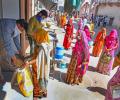
However, experts say that unless clear guidelines are there, it remains to be seen how many people fall within the ambit and who remains excluded.
 © 2026 Rediff.com - Advertise with us - Disclaimer - Privacy Policy - Sitemap - Feedback - About us - Terms of use - Grievances